Rockford Airport Taxi

Our hometown, from 1834 to today
We've been driving Rockford's streets for years, and every ride crosses a piece of history - the river the city is named after, the theaters of downtown, the old factory corridors. Here's the story of the city we call home.
Visiting Rockford to see the sights? We'll drive you - book online or call (815) 200-9604.
The ford on the river (1834-1852)
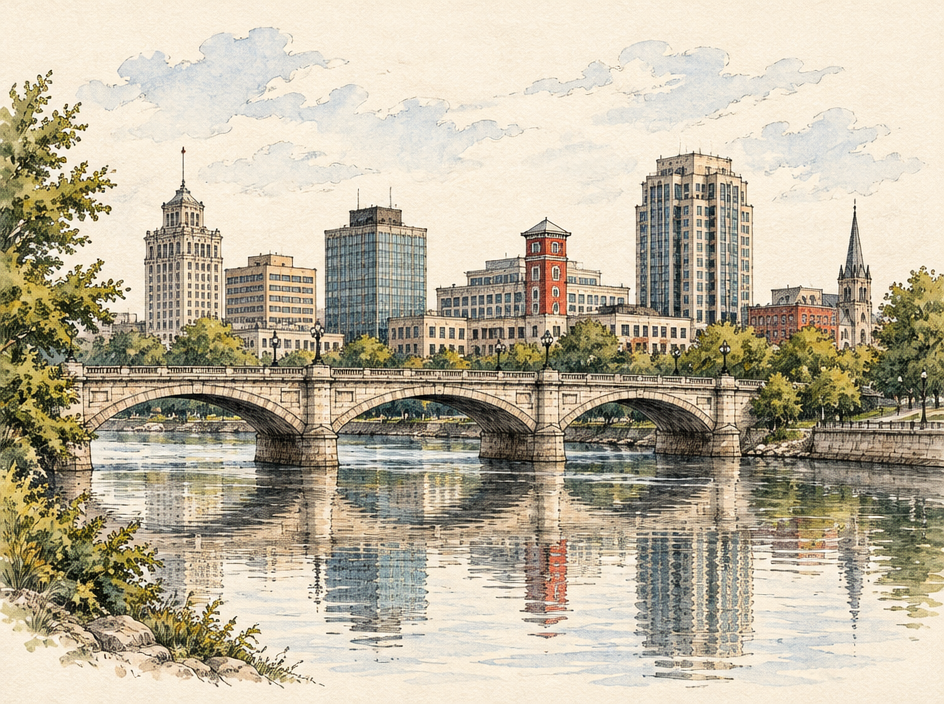
Rockford began in 1834, when settlers built cabins near a rocky crossing on the Rock River - a "rocky ford" that gave the city its name. The settlement grew on both banks, and by 1852 Rockford was incorporated as a city. The river that made the town still runs through the heart of it, crossed today by the historic downtown bridges we drive every day.
The Forest City and the furniture capital
In the 1800s Rockford was known as the Forest City for the dense elm and oak trees lining the river. Waves of Swedish immigrants arrived in the mid-1800s and turned Rockford into one of America's furniture-making capitals - at its peak, the city's factories shipped chairs, desks and cabinets across the country. That same craftsmanship built the Victorian homes you still see in the Haight Village and Signal Hill neighborhoods.
Baseball, war years and the Peaches
Rockford fielded one of professional baseball's first teams, the Forest Citys, back in the 1860s and 70s. During both World Wars, Camp Grant trained hundreds of thousands of soldiers on the city's south side. And from 1943 to 1954, the Rockford Peaches - a real women's professional baseball team - won four championships in the All-American Girls Professional Baseball League, the story later told in the film A League of Their Own.
Landmarks that still stand
- Coronado Performing Arts Center (1927) - the atmospheric "Wonder Theatre" on Main Street, still hosting concerts and shows.
- Tinker Swiss Cottage (1865) - a museum home above Kent Creek, built by furniture magnate Robert Tinker.
- Midway Village Museum - a Victorian village preserving Rockford's 19th-century streets.
- Anderson Japanese Gardens - begun in 1978, now ranked among the finest Japanese gardens in North America.
- Burpee Museum of Natural History - home of Jane, the world-famous juvenile T. rex.
Rockford today
Rockford gave the world the sock monkey (born at the Nelson Knitting Company), the rock band Cheap Trick, and one of the country's fastest-growing cargo airports - Chicago Rockford International Airport (RFD), now a major air-freight hub. Downtown has come back to life with the Hard Rock Casino, the riverfront Embassy Suites, and a full calendar of events at the BMO Center and Coronado.
See it with us
Whether you're flying into RFD, heading to O'Hare, or planning a day around Rockford's museums and theaters, we'll get you there. We serve Rockford, Loves Park, Machesney Park and the whole Stateline area, 24 hours a day.
Call (815) 200-9604 or book online - and if you'd like the full visitor rundown, see our guides on where to stay in Rockford and upcoming Rockford events.
Common Questions
Why is Rockford called the Forest City?
Rockford earned the nickname in the 1800s for the dense elm and oak trees along the Rock River. The name lives on in places like Forest City Road and the Rockford Forest Citys, one of baseball's first professional teams.
When was Rockford founded?
Rockford was founded in 1834 by settlers who built near a rocky ford across the Rock River - the crossing that gave the city its name. It was incorporated as a city in 1852.
What is Rockford famous for?
Its furniture-manufacturing era, the Rockford Peaches women's baseball team, the Coronado Theatre, Anderson Japanese Gardens, the sock monkey, and as the hometown of Cheap Trick.
Were the Rockford Peaches a real team?
Yes - the Peaches played in the All-American Girls Professional Baseball League from 1943 to 1954 and won four league championships, inspiring the film A League of Their Own.
O'Hare Car Service Near You
Rockford to O'Hare · O'Hare to Rockford · Belvidere to O'Hare · Loves Park to O'Hare · Machesney Park to O'Hare · Roscoe to O'Hare · Freeport to O'Hare · Beloit to O'Hare · Rockton · Bus alternative · Rockford to Midway · Rockford to Chicago · Rockford Airport (RFD) · Cherry Valley to O'Hare · Poplar Grove to O'Hare · Winnebago to O'Hare · Pecatonica to O'Hare · Oregon to O'Hare · DeKalb to O'Hare · Janesville to O'Hare · Where to Stay in Rockford · Rockford History · Hard Rock Casino Limo · O'Hare to Hard Rock Casino · O'Hare to Rockford Guide